Project Information & Footprint
Awaiting Verified Information
The current promotional website for the project (salix-data-center.com) relies on generic, vague assurances rather than concrete guarantees. Much of the information provided there is not backed by cited data or firm infrastructural studies.
We are actively researching the true infrastructural demands and ecological impact of the proposed data center. Below is a realistic comparison of projected resource demands based on similar regional projects and industry data.
Corporate Pledges vs. Binding Guarantees
The project's promotional materials tout a goal to replenish 120% of the water consumed by 2030. It is crucial to understand that this is a voluntary corporate pledge made by Google; it is not a binding municipal contract. If the facility depletes the Salix aquifer and fails to meet this 2030 target, there are no defined legal penalties, no operational pause triggers, and no community compensation mechanisms.
When reviewing these assurances, we must examine Google's documented historical behavior where voluntary pledges lacked strict local enforcement.
💨 The "Net Zero" Reversal
Google officially pledged to achieve net-zero emissions across all operations by 2030; however, the company's own 2024 Environmental Report revealed that their greenhouse gas emissions actually surged by 48 percent over five years. This massive increase was driven directly by new AI data center energy demands, proving that voluntary 2030 targets are easily abandoned when corporate infrastructural priorities shift.
💧 "Trade Secret" Water Data
While Google promises responsible local water stewardship, their historical actions demonstrate a deep resistance to transparency. In The Dalles, Oregon, Google actively fought public records requests and attempted to classify their massive local water consumption as a corporate "trade secret"; they only released the data after a prolonged legal battle and intense public backlash.
🏢 Phantom Economic Lifelines
Google frequently uses projections of community prosperity to secure decades of multi-million dollar property tax exemptions from rural towns; yet, once construction concludes, these highly automated facilities operate with a skeletal crew of technicians. Local municipalities are left carrying the heavy infrastructural burden without the legal clawback mechanisms required to recoup lost tax revenue if job promises fall short.
Resource Demands & Heritage Impact
🌾 Preserving Salix's Agricultural Heritage
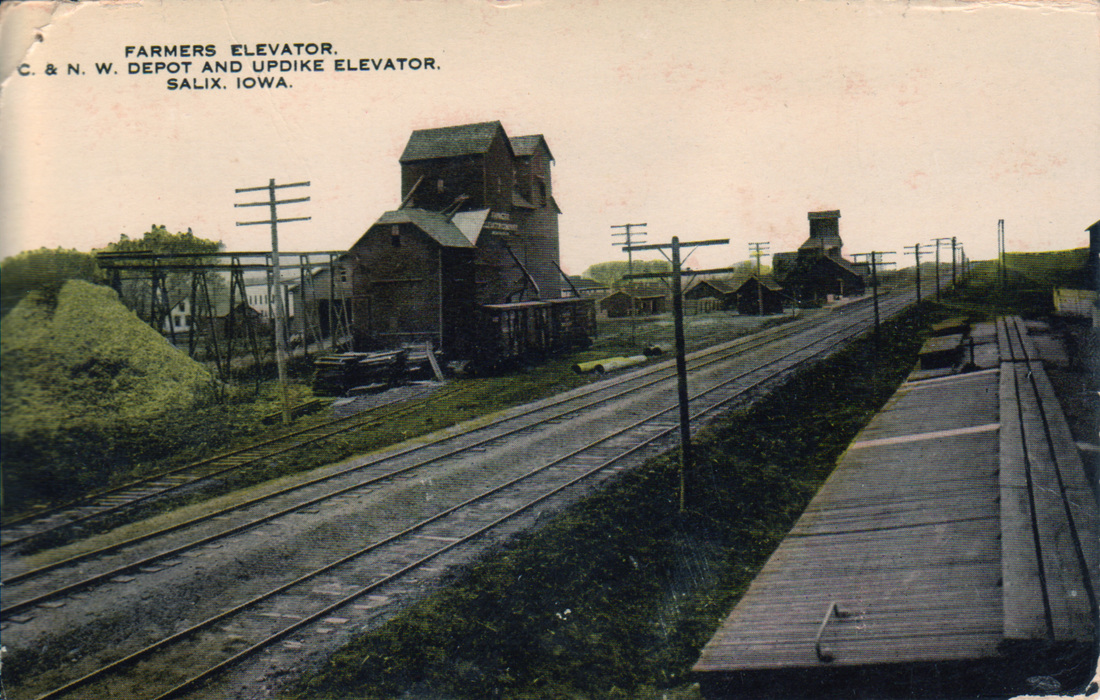
Farmers Elevator, C. & N. W. Depot, and Updike Elevator in Salix, Iowa.
Salix was platted around 1868 with the arrival of the railroad[a]. Our town's history is deeply rooted in the land. When a devastating fire swept through the business district in October 1892, these grain elevators were among the only structures left standing, serving as a testament to our agricultural backbone[a]. The proposed 900-acre industrial footprint threatens to pave over this rich farming heritage, trading generational farmland for massive corporate water and power consumption.
💧 Water Usage & Logistical Challenges
Data centers require massive amounts of water for cooling. For context, a similar data center project is proposed in Palo, Iowa, on roughly 500 acres. Public records show this facility is estimated to draw 14 million gallons of water per day directly from the Cedar River[b].
To put that staggering volume into perspective, the average day demand for water for the entire city of Sioux City is 13.75 million gallons per day[c].
The proposed Salix site is nearly double the size at 900 acres[d], suggesting an even higher demand. Furthermore, the Palo facility is located directly on top of a river to support its intensive water needs[b]. The Salix site is located miles away from the Missouri River, which creates massive logistical hurdles and severely threatens the local aquifer.
⚡ Energy Consumption & Hidden Water Costs
Data centers place an enormous, continuous strain on local power grids. We demand transparency regarding MidAmerican Energy's capacity to serve this 900-acre facility[d]. Crucially, the true water footprint is often hidden in these energy demands. The power plants that generate electricity for data centers consume significantly more water to cool their steam turbines than the data center uses on-site for its own cooling[e].
🔊 Noise Pollution
Industrial HVAC cooling systems and backup generators run 24/7. We are seeking firm, guaranteed noise mitigation strategies to ensure the facility does not disrupt the quiet, rural character of Siouxland.
Sources & References
- [a] SalixIowa.com. The Story of Salix.
- [b] Iowa Public Radio (June 2026). Palo City Council advances data center zoning ordinance despite pushback from residents.
- [c] City of Sioux City, Iowa. Utilities: Water Treatment Overview.
- [d] Data Center Map. MidAmerican Salix - Sioux City.
- [e] KETOS (July 2026). Data Center Water Use: Why the Power Plant Uses More.